More Pictures from Russia

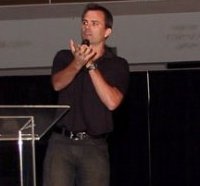
Here are some pictures from my time at camp in Siberia.

Small Victories

Sam tells a great story over at his blog.

Ugly American

I don’t care how “right” you think you are. If you come across in a mean-spirited way–you’re wrong.

Michael Moore, Ugly American


Michael Moore can handle verbal abuse from the conservative pundits in America, but harsh words from Pete Townshend, lead guitarist for The Who, may hit closer to his liberal heart.

“I greatly resent being bullied and slurred by him just because he didn’t get what we wanted from me,” Townshend told Ireland Online.

Moore wanted Townshend’s rock anthem “Won’t Get Fooled Again” for use on the soundtrack of his anti-Bush documentary film, “Fahrenheit 9/11.” Townshend refused, saying he thought Moore’s previous movies amounted to “bullying.” In response, Townshend said that Moore accused him of being a war supporter. Townshend says Moore’s attitude was evocative of President Bush’s war on terrorism credo: if you’re not with me, you’re against me.

“It seems to me that this aspect of his nature is not unlike that of the powerful and willful man at the centre of his documentary,” Townshend observed.

How easy it is to become like the thing we despise.

Reflecting on Russia

I’m back in the office today (sort of). I’m working through a little bit of jet lag. I was up most of last night and then I slept until about noon. Now I’m sitting here looking at my desk that I cleaned of all paperwork before I left and trying to remember what I left undone and what needs to be initiated. One thing about preaching is that no matter how clear your desk is, there is always a sermon you can be working on.

I’ve already sprinkled some reflections on my trip throughout my previous posts, so let me see if I can tie up some loose ends in this post.

If you ever get a chance to cheaply fly Business Class overseas, do it. It was the most enjoyable time I’ve ever spent on a plane. Here are some of the things that make flying up at the front of the plane so much fun: hot towels, a five-course gourmet meal, wine and cheese, multiple movies, reclining chairs with foot rests and lumbar support, and an amenity travel pack with ear plugs, eye cover, lotion, toothe brush, and fresh socks.

The only reason I was able to do such a thing was because of Rob’s familial connections to Delta Airlines. He and his family were gracious to make such a trip possible for me. I’m pretty sure this was one of the cheapest mission trips to Russia that has ever been taken.

Rob and his crew are doing a great job at the camp. It’s best described as a seed planting ministry. The short-term goal of the camp is not to get Russion kids to proclaim Jesus as Lord, but rather to plant the content and relational seeds of the gospel in their hearts. Each kid leaves with Russian and English Bibles and they leave having heard a variety stories and lessons from Scripture.

But more importantly I think is that they leave having been shown the love of Christ by the teachers and leaders of the camp. Rob has developed an outstanding relationship with the Russian government and they have given him the freedom to put on a life-changing camp for Russian kids. Rob is using his freedom in an extremely responsible and Christ honoring way. If Rob started using the camp as a “preach and dunk” opportunity he would undoubtedly alienate those who have given him this opportunity and the doors that have been thrown wide open would be shut. Because of the way Rob is doing business in Siberia, he has the opportunity to have a long-term influence in the spiritual formation of Russian youth. I can very easily see the influence the ministry he does at these camps extending beyond the borders of Russia. I couldn’t be more excited for him.

One of the genius moves Rob has made in running the camp is that he has on staff Russian co-teachers who are there to assist their English speaking counterparts with translation and teaching. Most of these co-teachers are not followers of Christ. They are young adults who love kids and want to work on their English skills. These co-teachers start interacting with the American teachers months in advance. They plan activities and curriculum and work out details via email. Really what they are doing is building relationships with each other. When the camp starts, the co-teachers translate what the American teachers say and they help teach the Bible lessons.

Somewhere along the way they find themselves hip-deep in Christian community. Through all of this, the gospel starts rubbing off. This is the third year of the camp and each year one of the co-teachers has been baptized. It is quite common and natural for the co-teachers to come away from camp with as many questions about Christianity as the kids do, maybe even more.

As I told Rob before I got on the plane, I think he is putting into practice a non-threatening, communal, participatory form of evangelism/discipleship that will work not only in Russia, but also in the States.

Nanotechnology

I make it a policy not to start taking something seriously until Prince Charles warns us against it. So here is some introductory material on nanotechnology.


The first products made from nanomachines will be stronger fibers. Eventually, we will be able to replicate anything, including diamonds, water and food. Famine could be eradicated by machines that fabricate foods to feed the hungry.

In the computer industry, the ability to shrink the size of transistors on silicon microprocessors will soon reach its limits. Nanotechnology will be needed to create a new generation of computer components. Molecular computers could contain storage devices capable of storing trillions of bytes of information in a structure the size of a sugar cube.

Nanotechnology may have its biggest impact on the medical industry. Patients will drink fluids containing nanorobots programmed to attack and reconstruct the molecular structure of cancer cells and viruses to make them harmless. There’s even speculation that nanorobots could slow or reverse the aging process, and life expectancy could increase significantly. Nanorobots could also be programmed to perform delicate surgeries — such nanosurgeons could work at a level a thousand times more precise than the sharpest scalpel. By working on such a small scale, a nanorobot could operate without leaving the scars that conventional surgery does. Additionally, nanorobots could change your physical appearance. They could be programmed to perform cosmetic surgery, rearranging your atoms to change your ears, nose, eye color or any other physical feature you wish to alter.

Nanotechnology has the potential to have a positive effect on the environment. For instance, airborne nanorobots could be programmed to rebuild the thinning ozone layer. Contaminants could be automatically removed from water sources, and oil spills could be cleaned up instantly. Manufacturing materials using the bottom-up method of nanotechnology also creates less pollution than conventional manufacturing processes. Our dependence on non-renewable resources would diminish with nanotechnology. Many resources could be constructed by nanomachines. Cutting down trees, mining coal or drilling for oil may no longer be necessary. Resources could simply be constructed by nanomachines.

Doug Pagitt has been going on and on about the theological implications of nanotechnology for some time now. I think I’m beginning to understand why. Pagitt recommends The Next Big Thing is Really Small for an introduction to some of the implications of all this. It may be worth checking out.