
Just Released: When To Leave

My blogging has been a bit erratic over the past couple of months. Mainly because I’ve been working on two little books that will be released within a couple of months of each other. Their content couldn’t be more different from each other. It’s been fun to go back and forth between the two.

The first went live on Amazon yesterday.

When To Leave: How To Know It’s Time To Move On (Before You Stay Way Too Long) is a follow-up to my first book, Before You Go. When to Leave was originally intended to be a short addendum to Before You Go. But the more I thought about all the issues I wanted to address, and as I began to sketch out my ideas, it was obvious that When To Leave needed to be a book, not a new chapter stuck at the end of Before You Go.

When To Leave is a more complicated than Before You Go because in many cases knowing when to leave is harder than figuring out where to go.

Because I push back against what conventional wisdom says about how long a pastor should stay at a church, there is plenty of room for disagreement over a few of the positions I take. I’ll be interested to see the feedback to a couple of chapters

I sent early versions of the manuscript out to a number a friends, several of whom aren’t pastors or ministers. They said the material was applicable to their situations as well. So even if you’re not a pastor there are probably a few principles in When To Leave that will speak to your situation.

Very little of When To Leave has made an appearance on this blog. Expect lots of new material and a few stories I haven’t told anywhere else.

Did you know it’s super easy to buy a Kindle book as a gift for someone else? You buy it and they get an email from Amazon telling them to come download their new book. If you’d like to get rid of your minister, When To Leave would make an excellent “hint” gift. Try it. If it works, let me know.

What are you waiting for? Go buy it!

Don’t have a Kindle reader?

Not a problem. It can be read on any device (Macs, PCs, iPads, iPhones, Android devices and Blackberries) with the Kindle reader app. (Available here)

The Dark Side: An Excerpt From When To Leave
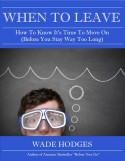
Here’s an excerpt from my new ebook available at Amazon.

The Dark Side: Why You Can’t Afford to Stay Way Too Long

“The world ain’t all sunshine and rainbows. It’s a very mean and nasty place and I don’t care how tough you are it will beat you to your knees and keep you there permanently if you let it. You, me, or nobody is gonna hit as hard as life. But it ain’t about how hard ya hit. It’s about how hard you can get hit and keep moving forward. How much you can take and keep moving forward. That’s how winning is done!”
—Rocky Balboa

Boxers need someone else to stop the fight on their behalf. They’ve been trained to fight to the bell, to keep swinging as long as they’re still standing, to not give up until someone gets knocked out.

Pastors can be a lot like boxers. You’ve been trained to expect difficulty in ministry. You expect opposition to every worthwhile initiative you promote. You’ve read the gospels and enough church history to know that religious people can do awful things in the name of God. You understand the implications of following a crucified Lord who embraced suffering as a means to redemption.

So when you step into the ring and stand toe-to-toe with a church that tends to direct its collective anxiety, anger, and disappointment toward their minister, you expect to take a few punches. It’s part of the job. What you don’t expect is for your opponents to be wearing gloves laced with plaster.  Nor do you expect them to land so many head shots.

•    They overwhelm you with unrealistic expectations.
•    They hold you accountable for things you have no authority to change.
•    After highlighting your every mistake, they break out the list of problems they have with your family.
•    They question your integrity and assume the worst about your motives.
•    They send you hateful, anonymous emails that hit your inbox at 10pm so you see them before heading to bed.
•    They ambush you in what’s supposed to be a routine meeting.
•    They invite you to lunch to tell you that you’re not good enough to get the job done.
•    They pour gasoline on rumors and fan the flame of gossip.
•    They put sugar in your gas tank.

Because you’re faithful, because you’re arrogant, because you follow a crucified Lord, because you don’t know any better, or because no one will throw in the towel on your behalf, you keep taking punches.

You sway, you stagger, you bleed, but you keep standing.

Just like a boxer who takes too many head shots, you sustain permanent damage. Not to your brain, but to your soul. The long-term effects of soul damage can be devastating.

•    You stop dreaming.
•    You stop hoping.
•    You stop praying.
•    You lose confidence in God.
•    You lose confidence in yourself.
•    You give up.
•    You stop following Jesus.
•    You stop loving your enemies.
•    You stop trusting others.
•    You give in to fear.
•    You start hating.
•    You radiate anger.
•    You become obsessed with revenge.
•    You do to others before they can do the same to you.
•    You rationalize your use of food, sex, or drugs to cope.
•    You justify your affair by deciding that God owes you one dalliance as compensation for what you’ve suffered.
•    You lose it all.
•    Your family moves on without you.
•    You wake up one morning wondering how you became the kind of person you despise.
•    You wonder if God still loves you.
•    You start looking for a way back.
•    You spend the rest of your days pondering what might have been.

This isn’t a game. It isn’t an academic exercise. It ceased being a philosophical discussion three minutes ago.

This is your life, your family, your calling, and your faith.

Your soul can only take so many punches.

If you were a boxer, would the people in your corner be shouting at the referee to stop the fight?

In Search of a Goldilocks Moment

Here is the latest draft of the introduction to my next e-book. I’m looking for some feedback on the premise that it’s better to stay too long than leave to early. Thanks for reading and responding.

******

Knowing when to leave can be harder than figuring out where to go.

My first e-book, Before You Go, focused on helping ministers discern if they should should accept a call to a new church. It assumed the decision to leave their current church already been made.

In Before You Go, I chose not to address the question of how to know when it’s time to leave your current church (or job). I can blame this omission on my desire to keep Before You Go short enough to read in one sitting. That would be true, but not totally accurate.

I also decided not to tackle the question of when to leave because in the past it’s been a question I’ve done a poor job of answering for myself.

While working in two very different, but equally challenging, church environments I was always more concerned with leaving too early than staying too long. Leaving is the natural response when things get tough. It’s the easy way out. I always worked with the assumption that the longer a pastor stays at a church the more effective he will be over time. I still believe this is true, but I also now understand that it is possible to stay in a bad situation too long.

I know this because I stayed too long—twice. In each case, I didn’t know I had stayed too long, until it was too late. And by too long, I don’t mean a few months too long. I mean a couple of years at each place. I’m confident that no one in either one of my previous churches will ever accuse me of is leaving too early. That’s not my M. O.

I’m the guy who stays too long.

And I’m okay with that, because I can’t stand the thought of being the one who leaves too soon.

I suppose this would make for an interesting philosophical argument over high quality grape juice: Which is worse, staying too long or leaving too early?

I’ll take the position that’s it’s better to stay too long than leave too soon. When we leave too soon, especially if it’s in response to difficult circumstances, we miss the opportunity to learn lessons that can only be taught by hardship, resistance, and disappointment.

Even so, it’s possible to stay in a bad situation so long that you can become overwhelmed with a kind of depressed cynicism that destroys your passion for ministry and erodes your self-confidence as a leader.

If only there was a way of figuring out when is the perfect time to say goodbye so that when we make our decision we know we’re standing squarely in the sweet spot of not bailing out too soon or overstaying our welcome.

That would be a Goldilocks moment.

Yes, such moments exist. But they are as elusive as a unicorn on roller skates.

And usually only recognizable in hindsight.

And usually more the result of luck than insight.

How many people do you know who can say they left their last job, sold their stock, or put their house on the market at precisely the right time?

How many of them can attribute their perfect timing to anything else but good fortune?

My premise in this book is that the best way to know when it is time to leave is when it starts to feel like you’ve stayed too long. Otherwise, you’ll be in danger of tapping out too early. That’s the kind of regret that can make you more miserable than staying too long ever will.

Why do so many great professional athletes play one season too many and retire only after it’s become painfully obvious that they no longer belong on the court or field anymore? Because they can’t stand the thought of quitting one year too soon. They’d rather embarrass themselves by staying too long than live with the regret of leaving too soon.

Why do some athletes try to make a comeback (usually ill-advised) after retiring? Because they’re haunted by the possibility that they left too soon.

The only sure-fire way to keep from leaving too soon is to make sure you stay too long. Just don’t stay so long that you fry your system and disqualify yourself from future opportunities.

With that goal in mind, I’m going to suggest some ways to recognize that you are on the verge of, or have already, stayed too long and that it’s time to move on.

I can guarantee that working through them will be more productive than trying to hunt down Goldilocks, who was last seen riding on the back of a roller-skating unicorn.